How to use notes to enrich your botanical sketchbook
Many people who begin botanical sketching quietly believe that a sketchbook has to be one thing above all else: beautiful.
Neat pages, harmonious colors, clean lines. And the moment a scribble slips out of place or a line turns too dark, it can feel as if the entire page is “ruined.”
Notes don’t seem to belong there at first glance.
They feel too factual, too messy, or not “artistic” enough. In reality, they can do exactly the opposite.
Notes make a sketch more personal and more alive.
They capture the moment, deepen your observation, and become incredibly helpful later on when you flip back through your pages and begin to see your own progress.
Botanical drawing is always, in some way, an act of observing nature and a few words in the margins can beautifully hold onto that feeling.
Notes are not a must.
They are a tool. And everyone gets to decide how or if they want to use them.
What you can write in your sketchbook
For many beginners, it feels unfamiliar at first to add anything beside the drawing itself. That’s why it helps to think in a few simple categories for inspiration.
Start simple
You might begin with something very basic: the name of the plant, if you know it. Or note where you found it, what the season feels like, or whether light was falling across the leaf.
These notes don’t have to be scientific. Sometimes a sentence like “found on the table after a walk” or “color feels much warmer than expected” is more than enough.
Training your perception
While drawing, you often notice things you hadn’t seen before
a texture,
the direction of a leaf vein,
a color you couldn’t quite place at first glance.
These kinds of observations are perfect for small notes. They help you move beyond simply drawing and into truly seeing. Learning how to observe.
Documenting color mixes
Color mixtures are also wonderful candidates for short notes. You can add small color swatches directly to your sketchbook or write down which pigments you combined.
Over time, many people develop a small personal “color recipe book” without ever consciously planning it.


Notes about materials
Then there are the technical details:
which brush size you used,
whether the fineliner was waterproof,
which paper felt particularly pleasant.
These notes may seem minor, but they become extremely useful later when you want to understand why a sketch turned out especially well.
Your own mood
Finally, you can capture how the moment felt.
Maybe you enjoyed the quiet in the kitchen. Maybe it was a brief moment just for yourself. Or perhaps you discovered a detail that surprised you.
How to place notes so the page feels harmonious
Many people worry that notes will make a page feel cluttered. In reality, it’s less about what you write and more about how you place it.
Headings or small titles, like the date or plant name, can give a sketch a natural structure.
If you enjoy a bit of decoration, you might use simple lettering or a small brush pen, but it doesn’t have to be elaborate.
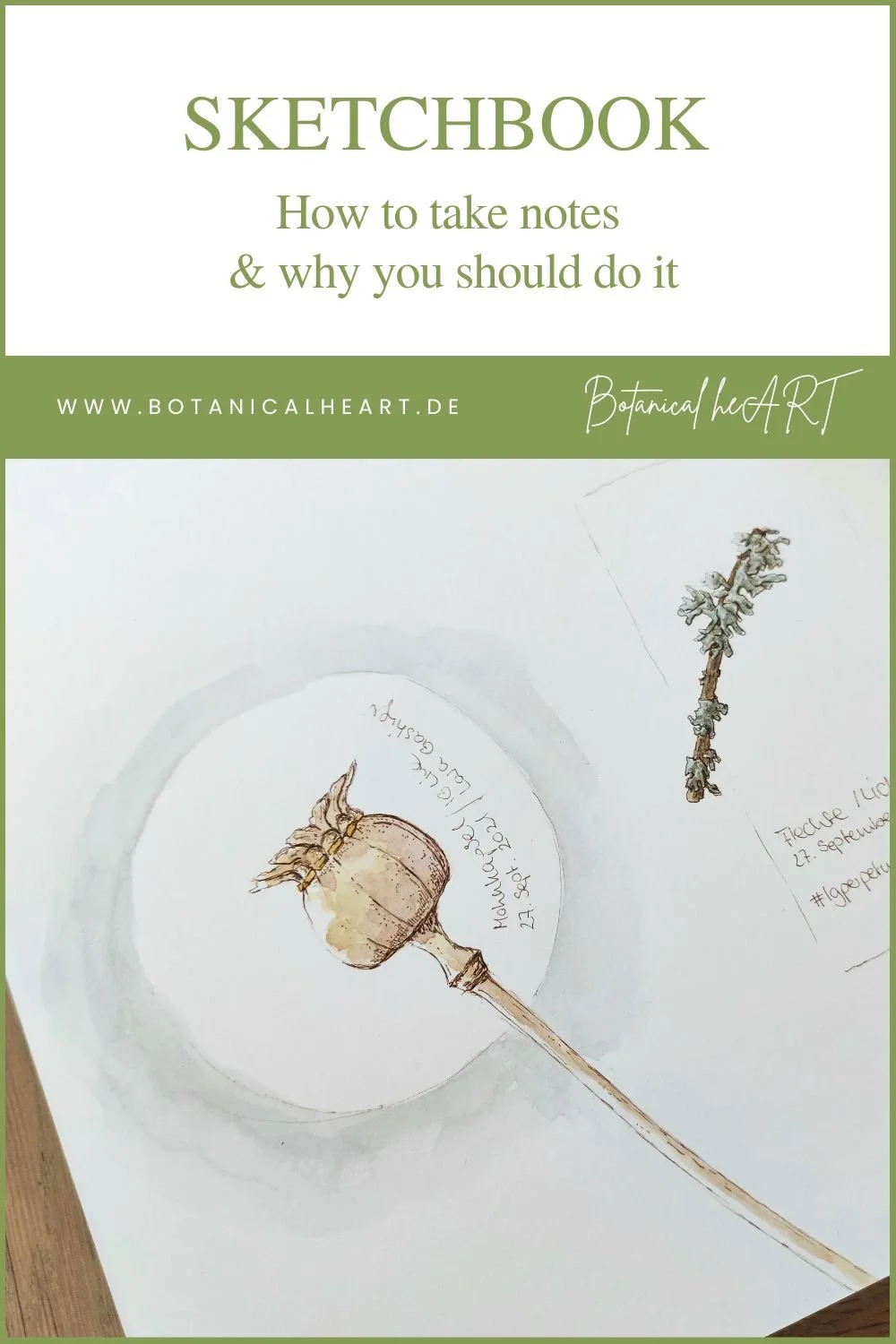
Short text blocks work well along the margins or beneath the drawing. They can be brief: a sentence, an observation, a color note. Some people add small color swatches beside them; others use tiny boxes or mini diagrams for color mixes.
If you prefer a very calm look, pencil is perfect for notes that are subtle and unobtrusive. If you like clear readability, a fineliner works well.
And if you enjoy structure, small stamps can be fun: a date, the weather, a tiny leaf. This works especially nicely for regular sketchbook pages.
Over time, you’ll discover how much space you want to give your notes. Some people write just a few words, others fill half a page, both are completely fine. You do you.
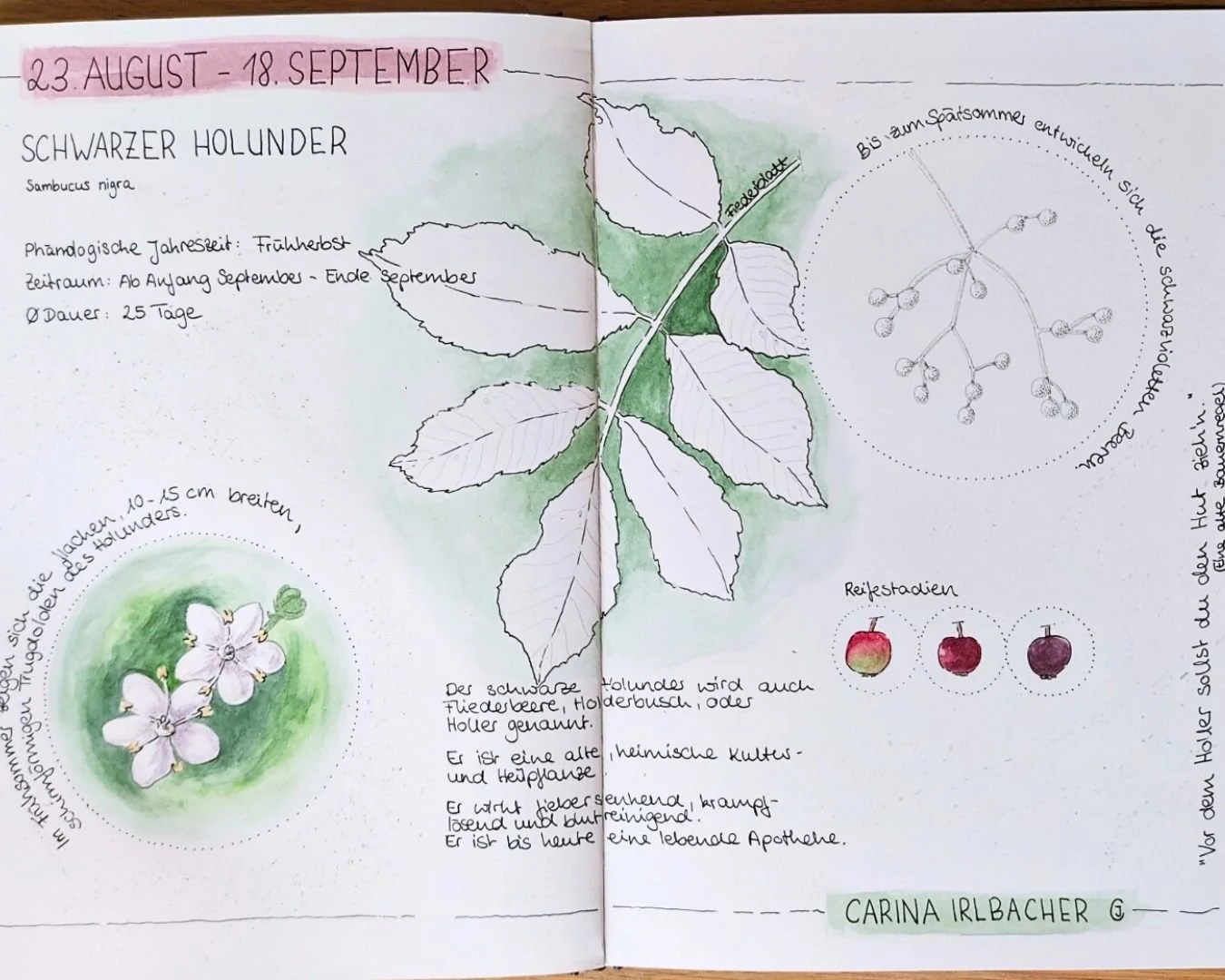
Sketchbook pages of Black Elderberry
Nature Journaling as inspiration
You may have come across the term Nature Journaling before. Behind it lies a beautiful approach: observe, sketch, take notes. Without the goal of creating a perfect page.
You can pick and choose elements from it that resonate with you. It’s not about documenting everything or being scientifically precise. It’s about experiencing nature more consciously and capturing small moments.
For botanical sketching in particular, this can be incredibly valuable. You begin to notice how colors shift in daylight, or how a bud opens from one day to the next. And if you like, you can capture all of that on the page.
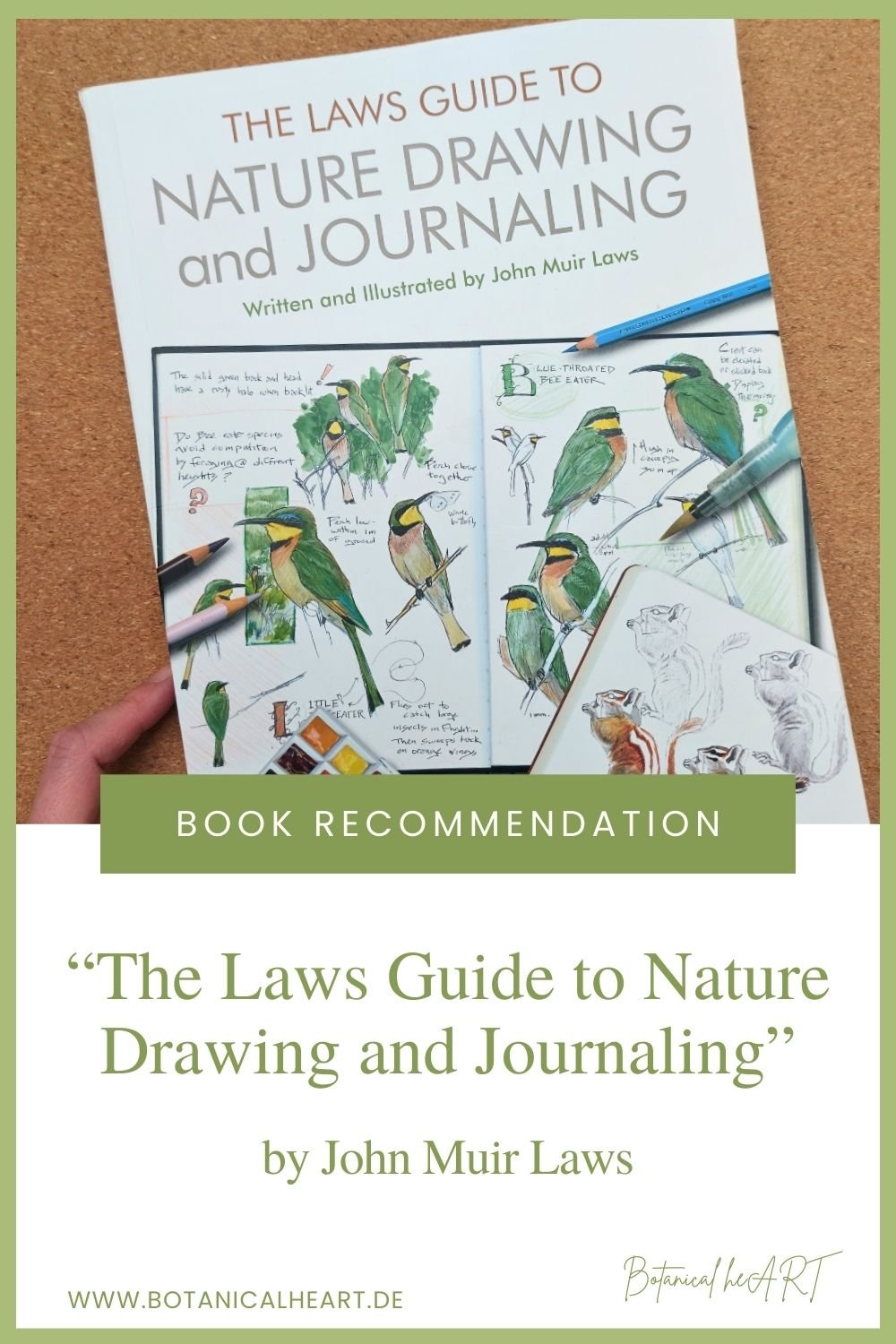
Read my book recommendation for Nature Journaling by John Muir Laws.
Mini exercise: Your first sketch with notes
This exercise is intentionally simple:
Choose a small botanical object. Sketch it loosely, without high expectations. Then write three short things beside it:
the name or where you found it,
a color that stood out to you,
and one short sentence about how the drawing moment felt.
If you like, add a small color swatch.
That’s all it takes. A page emerges that doesn’t just show a drawing, but also holds a small piece of memory.
Closing thoughts
Notes can enrich your botanical sketches without weighing them down. They help you understand plants more deeply, experience your process more consciously, and develop a personal style that grows naturally over time.
A sketchbook is not an exhibition space. It’s your personal place of discovery. And notes are a powerful part of that.
Pin this article on Pinterest!